
How Do Rats Get Into High-Rise Buildings in London?
High-rise buildings are often assumed to be protected from rodents simply due to height. In reality, rats are highly adaptable climbers and swimmers, and London’s dense infrastructure gives them multiple hidden routes into even modern apartment towers and office blocks.
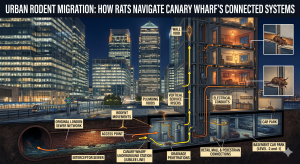
In areas such as Canary Wharf and the Isle of Dogs, infestations are increasingly linked to drainage systems, service voids, and waste handling rather than “street-level” access.
This guide explains, in detail, exactly how rats enter high-rise buildings, why it happens so frequently in London, and what actually works to prevent it.
Why High-Rise Buildings in London Are Not Rat-Proof
Height does not prevent entry because rats do not rely on ground-level access alone. Modern London developments share three key risk factors:
- Interconnected drainage systems across entire blocks
- Continuous vertical service cavities (pipes, cables, ducts)
- High food waste density in commercial and residential mixed-use buildings
In places like Canary Wharf, where restaurants, offices, and apartments share infrastructure, rats only need one access point to spread widely.
The Main Ways Rats Enter High-Rise Buildings
1. Drainage and Sewer Networks (Most Common Entry Route)
Rats frequently enter buildings through the sewer system, which is the single biggest risk factor in London.
How it works:
- Rats travel through main sewer lines
- They enter branch pipes connected to buildings
- They push through weak points such as broken pipe joints, missing or damaged seals, dry or faulty U-bends, or poorly maintained backflow systems
Why this matters in high-rises:
Even top-floor flats are connected to the same vertical drainage stack as ground-floor units. Once inside the system, rats can move upwards with ease.
2. Vertical Pipework and Service Risers
Inside every high-rise building are hidden vertical shafts carrying essential services. These include:
- Water supply pipes
- Heating systems
- Electrical cabling
- Fibre optic and telecom lines
Why rats use them:
- They offer continuous vertical access between floors
- They are often warm, dark, and undisturbed
- Gaps around pipe penetrations are rarely fully sealed
Rats can squeeze through gaps as small as 15mm and climb textured pipe insulation or rough surfaces.
3. External Climbing Access (Walls, Pipes, and Facades)
Rats are strong climbers and can scale surprisingly tall structures. They use:
- Rainwater pipes
- Drainpipes
- Brickwork imperfections
- Balconies and railings
- Scaffolding during maintenance work
In Canary Wharf-style developments, architectural cladding systems can also create hidden voids that act as highways for rodents.
4. Bin Stores and Waste Compactors
Waste management is one of the strongest attractants in high-rise infestations.
Common issues include:
- Overflowing communal bins
- Food waste left in hallways or service corridors
- Poorly sealed refuse rooms
- Faulty bin chute systems
Once rats establish a food source, they rarely leave and instead nest nearby within wall voids or basement areas.
5. Basement and Underground Infrastructure Access
Many London towers sit on complex underground structures. Rats often enter via:
- Basement car parks
- Storage rooms
- Service tunnels
- Utility corridors
From here, they move upward through risers and wall cavities.
This is especially relevant in Canary Wharf, where large underground service networks connect multiple buildings.
6. Building-to-Building Transfer
In dense developments, rats do not stay confined to a single building. They can move between:
- Adjacent towers via shared basements
- Underground service corridors
- Connecting podium levels
- External scaffolding or roofing gaps
This is why infestations often appear “suddenly” in multiple flats at once.
Structural Weak Points Rats Exploit
Rats rarely enter through “open doors”. Instead, they exploit construction gaps such as:
- Pipe entry points not properly sealed with fire-stopping material
- Gaps behind kitchen units and bathrooms
- Ceiling void access panels left unsecured
- Damaged drain covers
- Poorly fitted air bricks or vents
- Expansion joints in concrete structures
A single unsealed gap can allow repeated access even after treatment.
Early Warning Signs in High-Rise Flats
Residents often miss early signs because activity happens inside walls or ceilings.
Key indicators include:
- Scratching noises at night (walls or ceiling)
- Droppings in kitchen cupboards or under sinks
- Grease marks along skirting boards
- Sudden foul odours in void spaces
- Chewed packaging or wiring
- Unexplained pipe noise or movement sounds
Prevention Strategy (What Actually Works)
1. Proofing (most important step)
- Seal all pipe entry points with rodent-proof materials
- Install mesh over vents and air bricks
- Block gaps behind kitchen units and bathrooms
2. Waste control
- Keep bin stores locked and cleaned daily
- Avoid food waste in corridors or communal areas
- Ensure chute systems are maintained properly
3. Drain protection
- Fit non-return valves where possible
- Inspect drains for breaks or disconnections
- Maintain regular drainage checks
4. Building-wide coordination
Rodent control must be coordinated across:
- Flats
- Commercial units
- Management companies
Treating only one flat is rarely effective in high-rise environments.
Key Takeaway
Rats in London high-rises are not entering because of height, but because of hidden infrastructure pathways. Drainage systems, service risers, and waste networks create a connected environment that allows rodents to move vertically and horizontally with ease.
In areas such as Canary Wharf, prevention is less about reacting to infestations and more about continuous structural proofing and waste management discipline across the entire building.
Expert Pest Control Tips & Proven Methods to Eliminate Infestations Quickly and Effectively
- Why Do I Suddenly Have Ants in My Kitchen? (Hidden Causes Most Homeowners Miss)
- How Do Rats Get Into High-Rise Buildings in London?
- Why Professional Pest Clearance is Essential Before Moving Into a New Flat
- Eco-Friendly Pest Control: Are Green Methods Effective Against Common Pests?
- Heat Treatment vs Chemical Treatment for Bed Bugs: Which Works Best for Fast, Permanent Elimination in 2026?
- How to Stop Pigeons Roosting on Office Buildings in Canary Wharf
- Why Rodent Problems Are Increasing in City Centres Like Canary Wharf
- Cockroach Infestations in Canary Wharf: Causes and Professional Pest Solutions